Glass Bead Game Archive
The Glass Bead GameThe Glass Bead Game Archive is both the preserved vocabulary of the Glass Bead Game and a working instrument of its oversight. It records symbols and interpretations accepted into the Game, supports its players and officials, and gives institutional form to the effort to make knowledge across disciplines mutually legible. Its ordered store of signs stands in contrast to private associations that may be intensely meaningful to one person but cannot be made universally valid by explanation alone.
Role and Governance
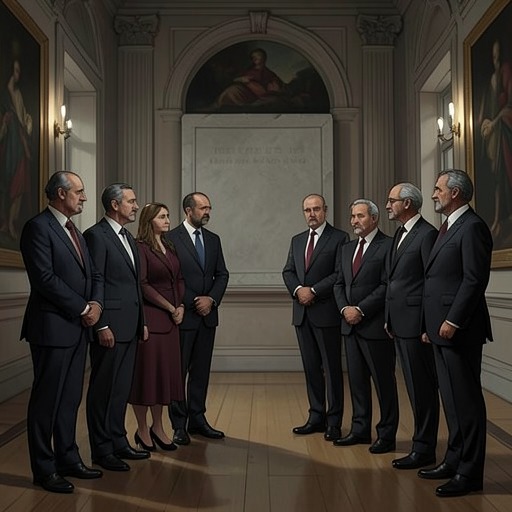
The Archive belongs to a system of commissions and officials responsible for guarding the Game’s language. The World Commission of the Magisters decides whether new symbols and formulas may be admitted to the existing stock, whether rules should be modified, and whether additional fields should enter the Game’s scope. Such additions have become rare. The national commissions, each under its Magister, collectively act as an academy protecting the vocabulary, development, and purity of what is presented as a world language for thoughtful people.
Each national commission maintains its own Archive of the Game: a register of symbols and decipherments that have been examined and accepted. The accumulated entries long ago surpassed the number of ancient Chinese ideographs. The Archive is therefore not merely a storehouse. Acceptance confers standing within a controlled symbolic system, while the commissions’ authority makes the preservation and extension of that system an institutional responsibility.
A Language Built from Many Disciplines
The Game’s rules, signs, and grammar form a highly developed secret language drawing on many arts and sciences, especially mathematics and music or musicology. Its symbols can express relations among the contents and conclusions of nearly all scholarly disciplines. The Game’s fixed structure functions like an immense musical instrument, with an established range of manuals, pedals, and stops; the Archive preserves the accepted signs through which players work within that structure.
The Game’s shared rules do not make its performances interchangeable. Even when two players choose the same small group of themes, their Games can take different courses and forms according to their minds, characters, moods, and skill. The Archive supplies a common vocabulary, not a single predetermined composition. Its stability enables communication, while the player’s particular handling of the signs keeps each performance distinct.
The Game’s musical model helps explain how that vocabulary is used. A play may begin from an astronomical configuration, a Bach fugue, or a sentence by Leibniz or the Upanishads. Players state and develop themes, vary them, and connect them with related ideas; beginners learn to establish parallels between musical works and scientific formulas, while experienced players weave themes into far-reaching combinations. The Archive’s accepted signs make these comparisons and transformations intelligible within a shared practice.
Selection, Training, and the Limits of Admission
The Archive’s vocabulary is guarded rather than freely expanded. At the annual Waldzell elite competition, candidates may use new symbols not yet admitted to the official code, making the contest an unusually open trial of possible additions. The highest distinction is not simply to win: it is to have proposed symbols accepted into the Archives and the language of the Game. Such recognition is rare; more commonly, the winner’s outline is performed as the year’s best candidate Game.
The competition thus joins invention to institutional judgment. Candidates can test possibilities beyond the canon, but the recognized extension of the Game depends on acceptance into the Archive. Thomas von der Trave had received this distinction roughly twenty-five years earlier for new abbreviations expressing the alchemical significance of zodiac signs; later, as Magister, he also contributed substantially to the study and classification of alchemy as a meaningful secret language.
The Archive is also part of the infrastructure through which the Players’ Village trains and selects practitioners. The Game’s director describes it as the heart and core of a rich, ordered apparatus served by everyone from the Magister and Archivist to the humblest errand boy. Courses and seminars reach hundreds, but the institution continues training those most devoted and capable toward the higher standards of genuine players. The Archive supports that ongoing practice, rather than merely supplying officials or preserving a finished canon.
Uses in Practice and Individual Limits
The Archive’s resources are practical as well as regulatory. During his Mariafels years, Knecht composed a Game for the Waldzell competition and entrusted its final elaboration and clean copy to Fritz Tegularius, who could work in the Waldzell Archives. Knecht gave him his drafts in person and discussed them alongside Tegularius’s own plan. The episode shows how the Archive provides a place and working resource for turning a player’s design into a completed competition entry, even while the player is away from Waldzell.
The Archive also preserves institutional memory across generations. In the Magister’s garden, Knecht consults the Pocket Calendar for the Magister Ludi, a guide written by Ludwig Wassermaler some seventy or eighty years earlier and amended by successive Masters. The calendar urges the Magister to begin thinking steadily about the coming annual Game, to note ideas, and sometimes to carry the pattern of a classical Game on official journeys. Its surviving instructions link the present officeholder to earlier practice, while the Archive makes the Game’s accumulated work available for consultation.
That public, preserved language has a limit. Knecht recounts how the fragrance of a freshly cut elder twig became bound in his memory to the opening chords of Schubert’s spring song, “Die linden Lüfte sind erwacht.” The scent and the music form a precious private association: he can describe it to others, but cannot transmit the experience so that it becomes their own reliable response. The contrast clarifies what the Archive can and cannot do. It can retain shared, examined signs and make relations among disciplines communicable; it cannot turn every singular sensation into a universally binding symbol.
Significance
The Glass Bead Game Archive embodies the tension between a language broad enough to connect the intellectual contents of culture and a system controlled closely enough to preserve common meaning. Its recorded signs enable players to compare music, mathematics, astronomy, philosophy, and other fields, while its commissions decide which additions belong to the recognized vocabulary. The Archive is at once the memory, working instrument, and boundary of the Game: it allows an immense variety of individual compositions, but makes their shared intelligibility depend on training, preservation, and institutional acceptance.